

- Accuracy: How complete/correct/accurate is the Agent’s response (LLM-as-a-judge)
- Performance: How fast does the Agent respond and what’s the memory footprint?
- Reliability: Does the Agent make the expected tool calls?
Accuracy
Accuracy evals use input/output pairs to measure your Agents and Teams performance against a gold-standard answer. Use a larger model to score the Agent’s responses (LLM-as-a-judge).Example
In this example, theAccuracyEval will run the Agent with the input, then use a different model (o4-mini) to score the Agent’s response according to the guidelines provided.
calculate_accuracy.py
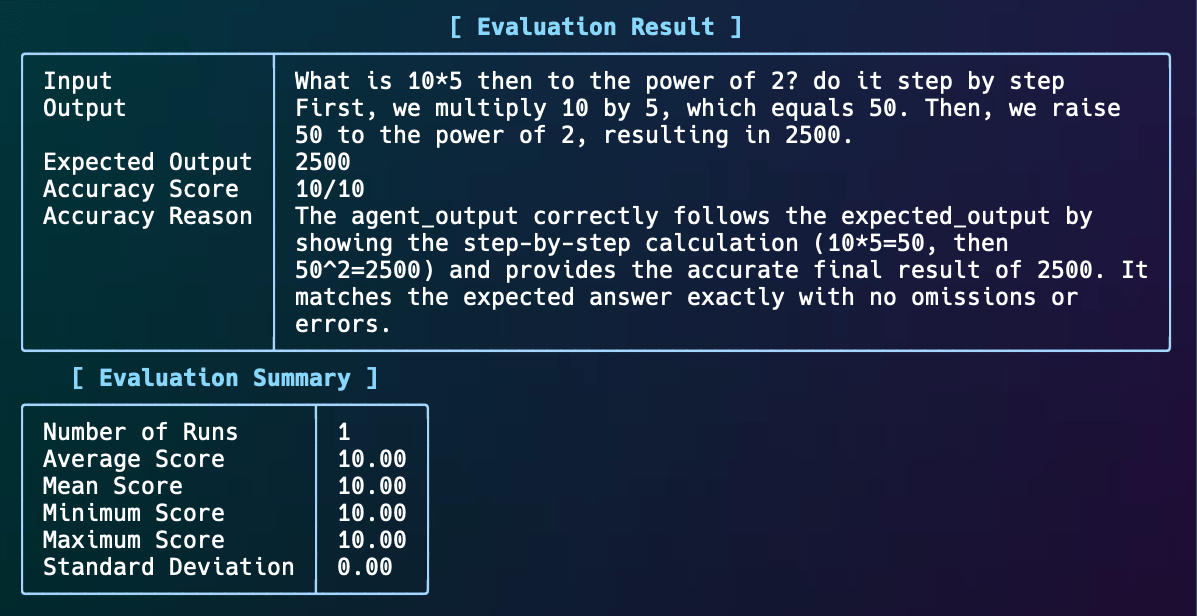
AccuracyEval on an existing output (without running the Agent).
accuracy_eval_with_output.py
Performance
Performance evals measure the latency and memory footprint of an Agent or Team.While latency will be dominated by the model API response time, we should still keep performance top of mind and track the Agent or Team’s performance with and without certain components. Eg: it would be good to know what’s the average latency with and without storage, memory, with a new prompt, or with a new model.
Example
storage_performance.py
Reliability
What makes an Agent or Team reliable?- Does it make the expected tool calls?
- Does it handle errors gracefully?
- Does it respect the rate limits of the model API?
Example
The first check is to ensure the Agent makes the expected tool calls. Here’s an example:reliability.py
Reliability evals are currently in
beta.